| Poly Mailer Pouch |
180 × 250 mm
250 × 350 mm
320 × 420 mm
400 × 500 mm
|
Co-extruded polyethylene film, commonly LDPE or LLDPE-based; recycled content may be specified when technically suitable.
|
Permanent pressure-sensitive adhesive flap; optional tamper-evident seal and double adhesive strips for returns.
|
Water-resistant, tear-resistant, lightweight, and suitable for non-fragile products. Not intended as a primary cushion for fragile goods.
|
Apparel, soft goods, documents, books, household textiles, and general e-commerce shipments.
|
- Confirm the applicable packaging and waste rules in the destination market.
- Request recycled-content documentation if a recycled-content claim is made.
- Verify that inks and adhesives are suitable for the intended use.
|
Check film thickness, seal strength, flap adhesion, tear resistance, dimensions, odor, print rub resistance, and batch consistency.
|
Low |
| Recycled-Content Poly Mailer |
180 × 250 mm
250 × 350 mm
320 × 420 mm
400 × 500 mm
|
Polyethylene film containing post-consumer or post-industrial recycled resin, usually with a defined percentage stated by weight.
|
Permanent adhesive flap; optional return strip and tamper-evident construction.
|
Good moisture resistance and flexibility. Recycled resin can affect clarity, color uniformity, odor, and mechanical consistency.
|
E-commerce apparel, retail returns, subscription shipments, and brands seeking reduced virgin-plastic use.
|
- Obtain a traceable recycled-content declaration or third-party verification.
- Do not use an unqualified “recyclable” claim; confirm local collection and recycling availability.
- Check environmental marketing claims against the destination country’s rules.
|
Test recycled-content percentage, tensile strength, puncture resistance, seal performance, odor, color variation, and contaminant control.
|
Low–Medium |
| Paper-Based Mailer Pouch |
180 × 250 mm
250 × 330 mm
300 × 400 mm
350 × 450 mm
|
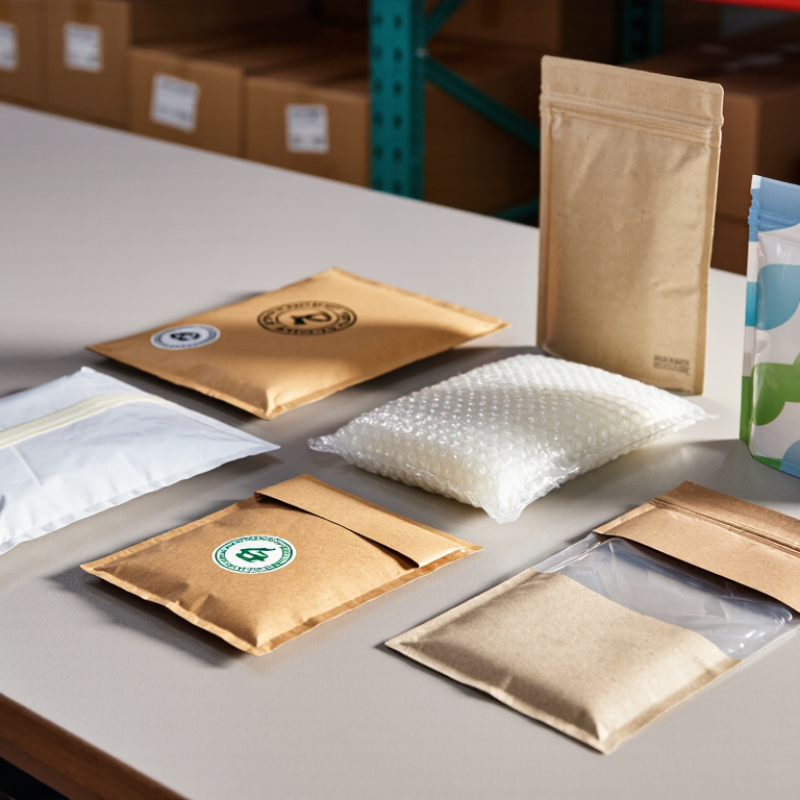
Kraft paper or other paper fiber structure; may include a water-based coating or a separate barrier layer.
|
Hot-melt adhesive flap; optional tear-open strip and second adhesive strip for returns.
|
Good printability and stiffness. Moisture resistance depends on coating and may be lower than polyethylene alternatives.
|
Apparel, stationery, books, light retail products, and shipments where a paper appearance is preferred.
|
- Confirm fiber composition and whether the pouch is recyclable in the target market.
- Identify coatings, laminations, windows, and adhesive components.
- For food-related use, obtain applicable food-contact documentation for the complete structure.
|
Check paper grammage, moisture resistance, burst strength, flap adhesion, tear-open performance, fiber consistency, and print rub resistance.
|
Low–Medium |
| Paper-Laminated Protective Mailer |
200 × 280 mm
250 × 350 mm
300 × 400 mm
400 × 500 mm
|
Kraft paper outer layers with an internal paper honeycomb, crumpled paper, or fiber cushioning layer.
|
Adhesive flap; optional tear strip, return strip, and tamper-evident closure.
|
Better cushioning and surface protection than a flat paper mailer. Water resistance depends on the outer treatment.
|
Cosmetics packaging, small electronics accessories, ceramics, books, and moderately fragile retail goods.
|
- Verify whether all components can enter the same recycling stream.
- Document any coating, adhesive, ink, or mixed-material component.
- Confirm packaging weight and dimensions for transport calculations.
|
Conduct compression, drop, vibration, puncture, edge-crush, closure, and dimensional tests using the actual product load.
|
Medium |
| Bubble-Lined Mailer Pouch |
120 × 180 mm
180 × 260 mm
240 × 330 mm
300 × 420 mm
|
Polyethylene outer film with an air-bubble polyethylene lining; paper-faced versions are also available.
|
Permanent adhesive flap; optional tamper-evident seal and return strip.
|
Provides cushioning against scratches, minor impact, and abrasion. It is not a substitute for certified dangerous-goods packaging.
|
Small electronics accessories, cosmetics containers, glass accessories, photographs, and delicate non-hazardous items.
|
- Confirm whether the liner and outer film can be separated for recycling.
- For electrical products, check whether the package is compatible with the product’s ESD requirements.
- Use product-specific drop testing before approving mass production.
|
Check bubble diameter, liner attachment, puncture resistance, impact protection, seal strength, and dimensional recovery after compression.
|
Medium |
| Rigid-Backed Mailer Pouch |
180 × 250 mm
230 × 320 mm
300 × 400 mm
Custom sizes for flat products
|
Paper or polyethylene mailer with an internal paperboard, corrugated board, or plastic stiffener.
|
Adhesive flap; optional peel-and-seal closure and tear strip.
|
Prevents bending and folding. The stiffener must be appropriately sized to avoid exposed sharp edges.
|
Photographs, certificates, prints, cards, thin books, artwork, and flat promotional materials.
|
- Identify the stiffener material and whether it is removable.
- Confirm the required recycling route for mixed-material constructions.
- Check whether the finished package complies with postal size and thickness limits.
|
Inspect flatness, corner protection, board caliper, bending resistance, edge safety, adhesive performance, and postal handling durability.
|
Medium |
| Stand-Up Zipper Pouch |
100 × 150 mm
140 × 200 mm
180 × 260 mm
220 × 300 mm
|
Flexible multilayer film, such as PET/PE, PET/CPP, or other application-specific structures; mono-material PE or PP options may be available.
|
Press-to-close zipper; optional slider, tear notch, laser score, or heat-sealed tamper-evident top.
|
Good resealability and product presentation. Barrier performance depends on the selected film and may include oxygen, moisture, aroma, or light protection.
|
Dry foods, pet treats, powders, personal-care refills, hardware, and small consumer products.
|
- For food contact, obtain a declaration of compliance for the complete structure and intended conditions of use.
- For EU markets, assess relevant food-contact requirements, including Framework Regulation (EC) No 1935/2004 and applicable plastic rules.
- For the United States, confirm compliance with the applicable FDA food-contact provisions for each material and adhesive.
|
Test zipper opening and closing cycles, top-seal strength, leak resistance, drop performance, migration where applicable, and filling-line compatibility.
|
Medium |
| Flat Three-Side-Seal Pouch |
80 × 120 mm
120 × 180 mm
180 × 250 mm
250 × 350 mm
|
Flexible film laminate or mono-material film selected according to moisture, oxygen, aroma, and heat-sealing requirements.
|
Heat-sealed top; optional tear notch, laser score, zipper, or easy-open seal.
|
Efficient use of material and strong package presentation. Barrier and seal performance depend on film selection and sealing conditions.
|
Snacks, powders, samples, wipes, accessories, medical consumables, and single-use products.
|
- Confirm sealant compatibility with the filling product and sealing temperature.
- For medical or pharmaceutical use, specify the required quality system and validation evidence.
- Verify product-contact, labeling, traceability, and shelf-life requirements.
|
Check seal width, seal strength, channel leaks, burst pressure, pinholes, film gauge, tear performance, and accelerated shelf-life data when needed.
|
Low–Medium |
| Spouted Stand-Up Pouch |
120 × 180 mm
150 × 230 mm
180 × 260 mm
220 × 320 mm
|
Flexible multilayer film with a heat-sealed fitment; structure selected for liquid, semi-liquid, or viscous products.
|
Screw cap, flip-top cap, or tamper-evident cap; fitment may be top-mounted or corner-mounted.
|
Suitable for controlled dispensing and resealing. Leak prevention depends on fitment design, weld quality, and cap torque.
|
Sauces, beverages, detergents, personal-care refills, gels, and household liquids.
|
- Obtain product-contact documentation for film, fitment, cap, ink, and adhesive components.
- Confirm child-safety, tamper-evidence, transport, and labeling requirements where applicable.
- Check compatibility with the product’s acidity, alcohol, oil, or surfactant content.
|
Perform leak, burst, cap-torque, fitment-pull, drop, inversion, thermal-cycle, and transport-simulation testing.
|
Medium–High |
| Vacuum Pouch |
120 × 180 mm
160 × 230 mm
200 × 300 mm
250 × 350 mm
|
High-strength multilayer film with a heat-sealable inner layer; barrier construction depends on oxygen and moisture requirements.
|
Heat seal, usually without a zipper; optional easy-open feature or valve for selected applications.
|
Removes air around the product and can reduce oxidation and package volume. It must be matched to vacuum equipment and product geometry.
|
Food products, textiles, industrial parts, and products requiring compact protection during transport.
|
- For food use, validate the complete material structure for the intended temperature and contact conditions.
- Confirm suitability for freezing, refrigeration, hot filling, or cooking if relevant.
- Establish shelf-life and seal-integrity requirements before ordering.
|
Test vacuum retention, seal strength, pinholes, puncture resistance, shrinkage, oxygen transmission, and compatibility with the vacuum machine.
|
Medium |
| High-Barrier Foil Pouch |
100 × 150 mm
140 × 200 mm
180 × 260 mm
220 × 320 mm
|
Aluminum foil laminate or metallized film laminate with heat-sealable inner layers.
|
Heat seal, zipper, tear notch, or valve depending on the product and required shelf life.
|
Very strong protection against light, oxygen, moisture, and aroma transfer when properly manufactured and sealed.
|
Sensitive food ingredients, coffee, powders, pharmaceuticals, chemicals, and products requiring extended shelf life.
|
- Confirm product-contact compliance and any pharmaceutical or chemical packaging requirements.
- Specify oxygen transmission rate and water-vapor transmission rate targets.
- Review recycling limitations because multilayer foil structures may not be accepted in all local systems.
|
Measure barrier performance, pinholes, flex-crack resistance, seal integrity, burst strength, residual odor, and lot traceability.
|
Medium–High |
| Compostable or Bio-Based Mailer Pouch |
180 × 250 mm
250 × 350 mm
320 × 420 mm
400 × 500 mm
|
Certified compostable film or bio-based polymer structure, depending on the specified end-of-life route and application.
|
Compostable adhesive flap, tear strip, or compatible closure system.
|
Lightweight and potentially suitable for specific composting systems. Moisture, heat, and shelf-life performance can differ from conventional polyethylene.
|
E-commerce soft goods, produce-related applications, event materials, and products with a verified composting pathway.
|
- Request certification for the exact finished pouch, not only for the raw resin.
- Distinguish industrial compostability from home compostability.
- Use clear disposal instructions and avoid implying universal biodegradability.
|
Check certification scope, disintegration, ecotoxicity, seal performance, tensile strength, moisture sensitivity, odor, and storage stability.
|
Medium–High |