

How to Choose the Best Poly Mailer for Your Business?
Choosing the right mailer starts with understanding what you ship, how it travels, and what customers expect when it arrives. A Ploy Mailer can suit lightweight, non-fragile products such as clothing, but the cheapest option is not always the best value. Check the mailer’s dimensions against a typical order, including folded garments or bundled items. A snug fit can reduce excess packaging, while too little room may strain the seams. Small details matter.
Material thickness, adhesive strength, water resistance, and opacity all affect performance. Compare product specifications, then test a few samples with real orders before committing to a large purchase. Fill a sample with a typical shipment, seal it, and handle it as it would be during packing and delivery. Watch for splitting corners, weak seals, or difficult opening. One test cannot represent every route, but it can reveal obvious problems.
This guide will help you weigh protection, cost, branding, and ease of packing against your business’s actual needs. Consider order volume and storage space, too: bulky cartons of mailers can crowd a small packing area. Recycled-content options may be worth comparing, but verify the supplier’s claims and check whether the mailer fits your local recycling practices. There is no perfect choice for every shop. A little trial and error is normal, and it is better to revise an order size than to assume one specification will work forever.
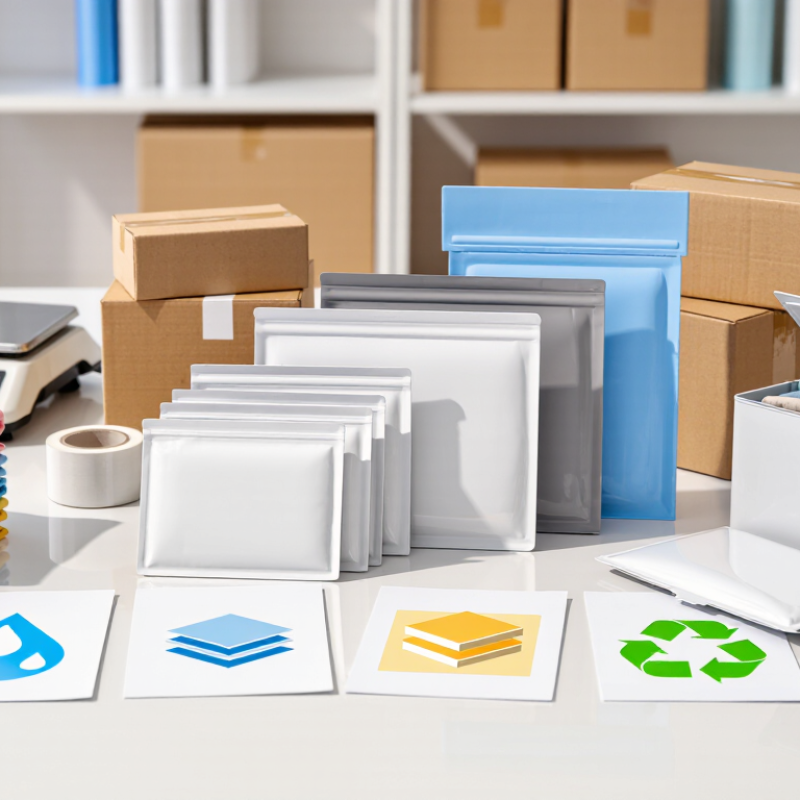
Identify Poly Mailer Types, Materials, and Common 2–4 mil Thicknesses
Poly mailers come in flat, gusseted, and padded styles. Flat mailers suit soft goods such as shirts; gussets add room for bulkier items, while bubble-lined versions cushion products against minor knocks. The 2023 Parcel Shipping Index counted 161 billion parcels worldwide in 2022 and projected 256 billion by 2027. More parcels mean more handling, but a thicker mailer is not automatically the better choice. Fit matters. An oversized bag can shift around a product, while a tight one may strain its seams.
Most mailers use polyethylene film, often low-density polyethylene for flexibility or layered co-extrusions for added toughness. Common film gauges run from 2 to 4 mil; one mil equals 0.001 inch. A 2-mil mailer can work for light apparel, while 3 mil offers a sturdier everyday option. Consider 4 mil for heavier contents or rougher handling, then test filled samples on your actual packing line. Check seals, corners, and abrasion after transit simulation. ASTM D882 provides a method for measuring plastic-film tensile properties, but gauge alone does not predict performance. Recycled-content films can vary, too. That is worth checking, not assuming.
| Mailer Type | Typical Material | Common Thickness | Best Suited For | Key Considerations |
|---|---|---|---|---|
| Standard flat poly mailer | Flexible polyethylene film, commonly LDPE or a PE blend | 2–2.5 mil (about 51–64 microns) | Soft goods such as clothing, fabric accessories, and other non-fragile items | Lightweight and water-resistant. Choose a larger size when the contents need room to move without stretching the seams. |
| Heavy-duty poly mailer | Polyethylene film, often a thicker or multi-layer PE construction | 3–4 mil (about 76–102 microns) | Heavier garments, dense soft goods, or shipments that need a sturdier outer bag | Thicker film can improve puncture and tear resistance, but it does not make an unpadded mailer suitable for fragile items. |
| Recycled-content poly mailer | Polyethylene film containing a stated proportion of post-consumer or post-industrial recycled PE | Commonly 2–4 mil (about 51–102 microns) | Non-fragile products where recycled content is part of the packaging specification | Check the supplier’s documented recycled-content percentage and confirm that the film meets your strength and appearance requirements. |
| Mono-material PE mailer | Polyethylene construction, often designed without mixed-material layers | Commonly 2–4 mil (about 51–102 microns) | Soft goods and businesses seeking a polyethylene-based mailer design | Recycling availability depends on local collection programs and the exact product design. Check local guidance rather than assuming curbside acceptance. |
| Bubble-lined poly mailer | Polyethylene outer film with a polyethylene bubble cushioning layer | Outer film may be 2–4 mil; cushioning adds thickness | Small items that benefit from light cushioning during shipment | Film gauge describes the outer film, not the cushioning performance. For fragile goods, assess the item’s protection needs and use suitable protective packaging. |
| Expandable or gusseted poly mailer | Flexible polyethylene film with side or bottom gussets | Commonly 2–4 mil (about 51–102 microns) | Bulky clothing or soft products that need extra packing depth | Check the usable width, depth, and seal area when filled; stated flat dimensions may not represent the packed capacity. |
| Tamper-evident poly mailer | Polyethylene film with a permanent or tamper-evident adhesive closure | Commonly 2–4 mil (about 51–102 microns) | Shipments where a sealed closure and visible evidence of opening are useful | Follow the closure instructions and verify that the adhesive works with the intended contents and storage conditions. |
Thickness note: One mil equals 0.001 inch, or 25.4 microns. Thickness alone does not determine durability; film formulation, construction, seams, closure quality, and package contents also matter.
Related Posts
-
China Top 10 Poly Mailer Manufacturers for Global Buyers?
-
How to Choose the Right Poly Mailer for Global Shipping?
-
Why Polymailer Bags Are Revolutionizing Sustainable Packaging for E-Commerce Businesses
-

2026 Top Large Poly Mailers Trends You Need to Know?
-
2026 Best Poly Mailer Suppliers for Global Buyers?
-
Best Polymailer Bags for Global Suppliers and Buyers?


